12 · When an Agent Must Ask
Contain a generated dangerous action with policy, execution-host controls, and human approval
Chapter brief
Question to answer
After a dangerous action is generated, who allows, asks, or denies it, and how is approval bound to that exact action?
By the end, you can
- Move permission decisions from prompts to an auditable execution boundary
- Define allow, ask, deny, and escalation paths
- Prevent approval replay, argument drift, and subagent privilege expansion
- Read this now if
- Engineers designing approvals, policy engines, least privilege, or human-in-the-loop control
- Prerequisites
- Understand tool calls, identity, and irreversible side effects
- Deliverable
- An action-level permission matrix and approval-token contract
- Evidence boundary
- Human confirmation covers only actions a person sees and understands; it does not replace host enforcement
Permission is decided before execution
Section titled “Permission is decided before execution”Scenario: the UI shows “deploy v42 to staging” and the user approves. Before execution, the model changes the argument to env=prod, or another user replays the same approval token. Approval exists, but not for the final action.
Passing conditions: approval binds canonical tool name, argument hash, identity, scope, and expiry; the token is single-use; any argument change asks again; subagents cannot inherit more authority than the parent; denial and timeout fail closed.
First locate the veto boundary
Section titled “First locate the veto boundary”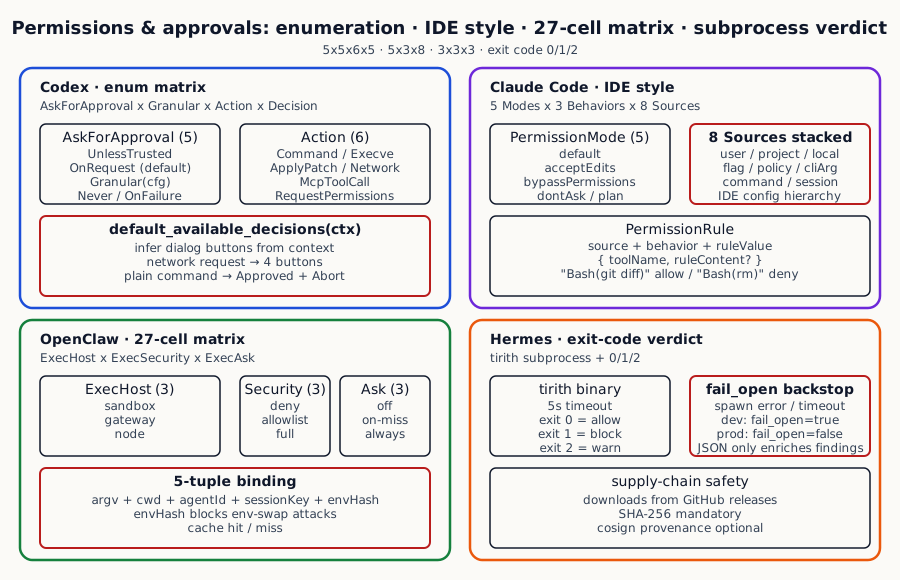
How the four systems cover the five permission-critical concerns:
| Dimension | Codex | Claude Code | OpenClaw | Hermes |
|---|---|---|---|---|
| Coarse mode | `AskForApproval` 5 variants: UnlessTrusted / OnFailure / OnRequest / Granular / Never | `PermissionMode` 5 values: acceptEdits / bypassPermissions / default / dontAsk / plan | `ExecAsk` 3 values: off / on-miss / always | No explicit mode; fail_open fallback on tirith failure |
| Fine-grained controls | `GranularApprovalConfig` 5 flags: sandbox / rules / skill / request_permissions / mcp_elicitations | `PermissionBehavior` (allow / deny / ask) + per-rule toolName + ruleContent | `ExecSecurity` 3 levels x `ExecHost` 3 backends = 9 plus 3 ExecAsk values = 27 combos | tirith findings JSON gives detailed reasons; verdict stays an exit code |
| Reviewable action types | `GuardianAssessmentAction` 6 variants: Command / Execve / ApplyPatch / NetworkAccess / McpToolCall / RequestPermissions | Unified canUseTool callback; each tool declares isConcurrencySafe / shouldDefer | Six typical operations: safe-bin / shell / fs / network / mcp / plugin (each routes to a different ExecHost) | tirith classifies by content: homograph URL, pipe-to-interpreter, terminal injection, etc. |
| Stacked decision sources | Per turn, `Constrained<AskForApproval>` sets the ceiling; session config + per-command escalation | 8 `PermissionRuleSource` levels: userSettings / projectSettings / localSettings / flagSettings / policySettings / cliArg / command / session | SystemRunApprovalBinding (argv + cwd + agentId + sessionKey + envHash) identifies the request; session cache | tirith verdict + fail_open fallback only; no layered rules |
| User answer granularity | `ReviewDecision` 5 variants: Approved / ApprovedExecpolicyAmendment / ApprovedForSession / NetworkPolicyAmendment / Abort | `PermissionBehavior` 3 values + per-rule persistence destination (5 destinations) | jsonl-socket requests live user answers; binding cache replays | No user-facing answer; tirith decides, agent forwards the rationale |
Source evidence: policy, host, and consent
Section titled “Source evidence: policy, host, and consent”Codex · Decomposing “permissions” into five orthogonal strongly-typed enums
Section titled “Codex · Decomposing “permissions” into five orthogonal strongly-typed enums”Permission is not one strictness slider. Codex separates approval modes, action types, and user answers, then derives visible buttons from request context; new enum branches reach compile-time checks.
Its solution is to define each dimension as a strongly-typed enum, forcing every “permission-related decision” in the code to explicitly state which dimension it is deciding on, and forcing the compiler to handle every variant.
The outermost layer of the whole system is 5 approval modes; this layer answers “how readily should the agent ask the user by default”:
Codex codex/codex-rs/protocol/src/protocol.rs:889-920 AskForApproval with 5 variants; Granular ships a fine-grained knob block
pub enum AskForApproval {    /// Under this policy, only "known safe" commands—as determined by    /// `is_safe_command()`—that **only read files** are auto-approved.    /// Everything else will ask the user to approve.    #[serde(rename = "untrusted")]    UnlessTrusted,
    /// DEPRECATED: *All* commands are auto-approved, but they are expected to    /// run inside a sandbox where network access is disabled and writes are    /// confined to a specific set of paths.    OnFailure,
    /// The model decides when to ask the user for approval.    #[default]    OnRequest,
    /// Fine-grained controls for individual approval flows.    #[strum(serialize = "granular")]    Granular(GranularApprovalConfig),
    /// Never ask the user to approve commands.    Never,}
The semantics of these 5 modes are very concrete: UnlessTrusted (also called “untrusted”) only auto-allows commands statically judged to be “definitely safe” read-only commands (think ls, cat), prompting on everything else; OnFailure is now marked deprecated (in theory “auto-allow everything and rely on the sandbox”, in practice the sandbox is not a panacea, so this mode is no longer recommended); OnRequest is the default and lets the model decide when to ask; Granular breaks the decision down further into 5 independent knobs (covered below); Never never asks, fitting CI and other clearly automated scenarios.
The Granular tier is where Codex’s engineering attitude really shows. It lets users separately configure “which kinds of operations require approval”.
There are 5 independent knobs: whether out-of-sandbox operations require approval, whether commands hit by the rules system require approval, whether skill invocations require approval, whether file-permission requests require approval, whether MCP server elicitations require approval.
Each is an independent boolean, so users can compose very specific combinations like “ask for shell commands, do not ask for rule-triggered commands, auto-deny MCP elicitations”.
The pragmatic reasoning behind this fine-grained decoupling: different operation types have wildly different risk levels, false-positive rates, and user tolerance. No single “strictness” slider can express that.
The “reviewable action” itself is also a strongly-typed enum, and this is the most distinctive feature of Codex’s permission system. It boxes every possible reviewable action into 6 variants, each carrying the fields it needs:
Codex codex/codex-rs/protocol/src/approvals.rs:134-170 GuardianAssessmentAction 6 variants, each carrying its own context payload
pub enum GuardianAssessmentAction { Command { source: GuardianCommandSource, command: String, cwd: AbsolutePathBuf, }, Execve { source: GuardianCommandSource, program: String, argv: Vec<String>, cwd: AbsolutePathBuf, }, ApplyPatch { cwd: AbsolutePathBuf, files: Vec<AbsolutePathBuf>, }, NetworkAccess { target: String, host: String, protocol: NetworkApprovalProtocol, port: u16, }, McpToolCall { server: String, tool_name: String, connector_id: Option<String>, connector_name: Option<String>, tool_title: Option<String>, }, RequestPermissions { reason: Option<String>, permissions: RequestPermissionProfile, },}Six action types means six structurally-different approval requests:
- Command is for shell strings (
git push origin main): the dialog shows the raw command and the working directory. - Execve is for direct executable invocations (no shell interpretation), more precise than Command (no shell metacharacter ambiguity), showing program, argv, and cwd.
- ApplyPatch is for file edits: the dialog shows the list of files about to be touched so the user can see what’s changing before the agent acts.
- NetworkAccess is for outbound network calls, showing target host, protocol, port for the user to judge the outbound.
- McpToolCall is for invoking a tool on a specific MCP server, showing the MCP server name, tool name, and optional connector identifier.
- RequestPermissions is for when the agent proactively declares “I need a wider permission scope”, showing the reason and the permission profile being requested.
Making approvals into strongly-typed variants buys this: each approval’s UI, risk level, and memory policy can be tuned independently, instead of stuffing everything into a weak { type: string, details: object } bag.
What answers can the user give in the approval dialog? Another enum, with 5 values: approve once, approve and propose an execpolicy amendment (so future similar commands auto-approve), approve for the whole session, approve and propose a network-policy amendment, abort.
The last two, “approve and propose a rule amendment”, are very clever design: they give the user a shortcut for “approve this and also don’t bother me again on the same thing”, turning the approval itself into a channel for the permission system to self-evolve.
The cleverest piece is a function called default_available_decisions. It inspects the current request’s context (does this approval involve network? does it carry an execpolicy amendment proposal? does it involve extra filesystem permissions?) and dynamically infers “which buttons should this dialog show”:
Codex codex/codex-rs/protocol/src/approvals.rs:288-322 Context-driven button selection: network plus proposal = many buttons; plain command = Approved plus Abort
pub fn default_available_decisions(    network_approval_context: Option<&NetworkApprovalContext>,    proposed_execpolicy_amendment: Option<&ExecPolicyAmendment>,    proposed_network_policy_amendments: Option<&[NetworkPolicyAmendment]>,    additional_permissions: Option<&AdditionalPermissionProfile>,) -> Vec<ReviewDecision> {    if network_approval_context.is_some() {        let mut decisions = vec![ReviewDecision::Approved, ReviewDecision::ApprovedForSession];        if let Some(amendment) = proposed_network_policy_amendments.and_then(|amendments| {            amendments.iter().find(|a| a.action == NetworkPolicyRuleAction::Allow)        }) {            decisions.push(ReviewDecision::NetworkPolicyAmendment { /* ... */ });        }        decisions.push(ReviewDecision::Abort);        return decisions;    }
    if additional_permissions.is_some() {        return vec![ReviewDecision::Approved, ReviewDecision::Abort];    }
    let mut decisions = vec![ReviewDecision::Approved];    if let Some(prefix) = proposed_execpolicy_amendment {        decisions.push(ReviewDecision::ApprovedExecpolicyAmendment { /* ... */ });    }    decisions.push(ReviewDecision::Abort);    decisions}
This block of logic reads like a product spec; it uses code to define “in network scenarios show these buttons, in file-permission scenarios show those buttons, in plain command scenarios show another set”.
This “context drives button list” approach is the soul of Codex’s permission system: the approval dialog’s UI is not hard-coded to “always 3 buttons” but dynamically derived from which fields the request carries: carrying network_approval_context shows “approve + approve for session + (optional) modify network policy + deny”; carrying additional_permissions shows only “approve + deny”; a plain command shows “approve + (optional) modify execpolicy + deny”.
Claude Code · Organising permissions by the logic of an IDE configuration system: three layers of “origin” determine priority, rules can override across layers
Section titled “Claude Code · Organising permissions by the logic of an IDE configuration system: three layers of “origin” determine priority, rules can override across layers”IDE users need to know where a rule came from. Claude Code models user, project, policy, and session sources as traceable fields, while PermissionMode chooses whether the result is allow, deny, or ask.
The reasoning: permission rules in a project, under a team’s policy, on a machine, with command-line arguments, inside a session may come from completely different places, and the system must clearly express “which layer this rule comes from”, or users have no way to debug “why was this operation allowed/denied”.
Claude Code claude-code/src/types/permissions.ts:14-80 5 PermissionModes + 3 Behaviors + 8 Sources + per-tool ruleContent
// ============================================================================// Permission Modes// ============================================================================
export const EXTERNAL_PERMISSION_MODES = [  'acceptEdits',  'bypassPermissions',  'default',  'dontAsk',  'plan',] as const
// Exhaustive mode union for typechecking.export type InternalPermissionMode = ExternalPermissionMode | 'auto' | 'bubble'
// ============================================================================// Permission Behaviors// ============================================================================
export type PermissionBehavior = 'allow' | 'deny' | 'ask'
// ============================================================================// Permission Rules// ============================================================================
/** * Where a permission rule originated from. */export type PermissionRuleSource =  | 'userSettings'  | 'projectSettings'  | 'localSettings'  | 'flagSettings'  | 'policySettings'  | 'cliArg'  | 'command'  | 'session'
export type PermissionRuleValue = {  toolName: string  ruleContent?: string}
export type PermissionRule = {  source: PermissionRuleSource  ruleBehavior: PermissionBehavior  ruleValue: PermissionRuleValue}
The 5 permission modes correspond to 5 actual workflows:
- default: standard mode, decisions made by the rules system. The default for most interactive scenarios.
- acceptEdits: auto-approve all file edits. Designed for IDE pair-programming. Developers and agents iterate on a piece of code, and asking “should I write this file?” every time would be unbearable, so file writes get a blanket pass.
- bypassPermissions: the “YOLO mode” that skips all approvals; documentation explicitly states it should only be used in CI or controlled environments.
- dontAsk: let the model decide, no prompts. The difference from default is that default still triggers rule-based approvals; dontAsk skips everything.
- plan: planning mode where all side-effect tools (file write, command execution, network access) are disabled. The agent can plan in its head but cannot act. Designed for the “let me see what the agent intends to do first” scenario.
Internally there are also auto (feature-flagged smart classifier) and bubble (defer decision to the parent turn) modes, mainly for nested agent invocation scenarios.
The most distinctive part is the 8 rule origins. They map directly to a real IDE configuration system’s structure:
- userSettings (
~/.claude/settings.json): the user’s global preference. - projectSettings (
.claude/settings.json): shared by the project, committed to git, visible to all team members. - localSettings (
.claude/settings.local.json): project-local, gitignored, only on this machine. - flagSettings: rules passed in via CLI startup flags.
- policySettings: enterprise IT department’s enforced policy; highest priority; cannot be overridden by any user config.
- cliArg: one-shot CLI arguments (
--allow-bash), valid for this launch only. - command: temporarily injected by a slash command.
- session: temporarily granted by the user mid-conversation (by clicking “approve this once”).
Why so many layers? Because each layer has a real user-workflow scenario: user preferences cannot be overridden by project config (otherwise you’d reconfigure on every machine you SSH into), project-shared config cannot be overridden by user preferences (otherwise git pull doesn’t bring rule changes), enterprise policy cannot be overridden by any lower layer (a compliance requirement).
Every rule carrying its own source field means users debugging a permission decision can immediately see “oh this Bash-deny rule comes from policy, not from my settings”.
PermissionRule also separates toolName and ruleContent, meaning rule granularity can be as precise as the sub-command level, like “allow Bash(git diff) but deny Bash(rm)”, much more useful than the coarse “all-or-nothing per tool” binary granularity.
OpenClaw · A three-dimensional matrix of execution host × security level × ask policy gives operators a real knob board
Section titled “OpenClaw · A three-dimensional matrix of execution host × security level × ask policy gives operators a real knob board”Operators care where a command runs, how it is filtered, and when the user is interrupted. OpenClaw keeps those dimensions separate and includes cwd, agent, session, and environment in the approval binding.
In enterprise agent deployment, ops have to answer: “Which execution environment does this agent run in? Sandbox or host? Is the default safety stance fully-denied, allowlist, or fully-permitted?
When does the user have to be interrupted?” These three questions have completely different answers in different deployment shapes, and a single “strictness” slider cannot express it.
OpenClaw’s solution is to model these three independent dimensions as independent enum types:
OpenClaw openclaw/src/infra/exec-approvals.ts:10-36 Three independent dimensions, 3 x 3 x 3 = 27 execution environment combinations
export type ExecHost = "sandbox" | "gateway" | "node";export type ExecSecurity = "deny" | "allowlist" | "full";export type ExecAsk = "off" | "on-miss" | "always";
export function normalizeExecHost(value?: string | null): ExecHost | null {  const normalized = value?.trim().toLowerCase();  if (normalized === "sandbox" || normalized === "gateway" || normalized === "node") {    return normalized;  }  return null;}
export function normalizeExecSecurity(value?: string | null): ExecSecurity | null {  const normalized = value?.trim().toLowerCase();  if (normalized === "deny" || normalized === "allowlist" || normalized === "full") {    return normalized;  }  return null;}
export function normalizeExecAsk(value?: string | null): ExecAsk | null {  const normalized = value?.trim().toLowerCase();  if (normalized === "off" || normalized === "on-miss" || normalized === "always") {    return normalized;  }  return null;}
The semantics of each dimension are concrete:
ExecHost answers “in which process context does this command run”. sandbox means in an isolated container/sandbox (safest but with startup overhead), gateway means inside the gateway process (medium, reusing process resources), node means directly in the host Node.js process (fastest but no isolation at all).
ExecSecurity answers “what is this execution environment’s default safety stance”. deny means everything is forbidden by default (must be explicitly allowlisted to run), allowlist means only allowlist-permitted commands run, full means everything is permitted by default (unless explicitly denylisted).
ExecAsk answers “when do we interrupt the user”. off means never ask, on-miss means ask only when “wants to run but the allowlist would forbid”, always means ask every time.
Independent combinations across three dimensions theoretically give 27 possibilities (3×3×3); about 4-5 are meaningful.
For example, host=sandbox / security=allowlist / ask=on-miss is a very typical production config: “run in a sandbox, auto-allow allowlisted commands, prompt the user when something falls outside the allowlist”.
Another, host=node / security=deny / ask=off, is a very strict lockdown mode: “run directly on the host, default-deny everything without bothering the user, effectively letting the agent execute nothing”, fitting “let the agent think but not act” scenarios.
The biggest engineering value of separating these three dimensions is: ops can change one dimension without disturbing the other two.
For example, downgrading production from sandbox to node (sandbox broken, temporarily degrading) does not require re-deciding “should the default safety stance change”; the other two dimensions stay put.
Once granted, OpenClaw never makes the user re-approve the same command. It uses a 5-tuple as the unique key for caching approvals:
export type SystemRunApprovalBinding = { argv: string[]; cwd: string | null; agentId: string | null; sessionKey: string | null; envHash: string | null;};These 5 fields together decide “is this execution the same approval as before”. The envHash field deserves a special note: it folds an environment-variable hash into the approval key, defending against a very subtle attack: a user approves python script.py under one PATH (where python resolves to the system Python); an attacker quietly modifies PATH so python now resolves to a malicious script; the next time the agent runs the same command, if environment is not considered, the cache hits and the malicious script runs unapproved.
With envHash in the binding, any environment change invalidates the cache and forces a re-approval, plugging the attack.
This “5-tuple binding” also means the same command takes different approval paths in different directories, different agents, different sessions, and different environments.
It is not a simple global allowlist but fine-grained to the specific context.
Hermes · Do not decide permissions itself; delegate everything to an independent subprocess called tirith, communicating only via exit code
Section titled “Hermes · Do not decide permissions itself; delegate everything to an independent subprocess called tirith, communicating only via exit code”Content scanning can live outside conversation logic. Hermes calls the tirith subprocess, treats its exit code as the verdict, and uses JSON only for findings; fail_open should be documented with the deployment threat model.
Concretely, all content-level permission checks are delegated to an independent subprocess called tirith, and the entire permission system’s verdict comes from a single source: the tirith subprocess’s exit code.
Hermes hermes-agent/tools/tirith_security.py:1-25 tirith is an independent Go binary; exit code is the sole verdict source of truth
"""Tirith pre-exec security scanning wrapper.
Runs the tirith binary as a subprocess to scan commands for content-levelthreats (homograph URLs, pipe-to-interpreter, terminal injection, etc.).
Exit code is the verdict source of truth:  0 = allow, 1 = block, 2 = warn
JSON stdout enriches findings/summary but never overrides the verdict.Operational failures (spawn error, timeout, unknown exit code) respectthe fail_open config setting. Programming errors propagate.
Auto-install: if tirith is not found on PATH or at the configured path,it is automatically downloaded from GitHub releases to $HERMES_HOME/bin/tirith.The download always verifies SHA-256 checksums.  When cosign is available onPATH, provenance verification (GitHub Actions workflow signature) is alsoperformed.  If cosign is not installed, the download proceeds with SHA-256verification only — still secure via HTTPS + checksum, just without supplychain provenance proof.  Installation runs in a background thread so startupnever blocks."""
That docstring looks brief, but four important engineering decisions are hidden in it:
The first decision is making exit code the sole verdict source. Subprocess communication typically forces a choice: do you parse JSON from stdout for a “verdict” field, or do you read the process exit code? JSON can carry richer information (findings list, confidence, recommended action), but it also means handling parse failure, JSON truncation, and missing fields. Exit codes have only a few fixed values (0/1/2), which narrows the parsing surface; crashes, timeouts, and unknown codes still need explicit handling. Hermes’s choice is use exit code for verdict, use JSON to enrich findings. In the cited implementation a broken JSON payload does not change a readable exit code, but that is not a guarantee for every execution failure.
The second decision is fail_open fallback. Subprocess communication inevitably hits operational failures: the subprocess fails to start, times out, returns an exit code outside the expected range (anything other than 0/1/2), or panics suddenly. What should the system do? Allow (fail_open) or deny (fail_closed)? Neither is universally right: fail_open is dev-friendly (you can still use the agent without tirith installed), fail_closed is production-friendly (when in doubt, block). Hermes hands the decision to the user via config: dev sets fail_open=true for fault tolerance; production sets fail_open=false for safety.
The third decision is auto-download + SHA-256 + optional cosign verification. tirith is an independent Go binary, and Hermes does not force-depend on it; it detects that tirith is missing and downloads it from GitHub releases to $HERMES_HOME/bin/tirith automatically. But “auto-downloading a binary” is itself an attack surface (DNS hijack, man-in-the-middle, compromised GitHub account). Hermes uses HTTPS, a SHA-256 check against the expected digest, and an optional GitHub Actions workflow signature. The digest or signature still depends on a trusted release source; a checksum is not independent provenance proof.
The fourth decision is keeping installation off the startup critical path. Tirith downloads in a background thread, avoiding a direct network-and-install dependency during startup. The time saved depends on package size, network, and cache; the source provides no portable benchmark.
Compared with the previous three systems, Hermes provides no fine-grained approval UI and has no concept of “user can temporarily allow”. It fully outsources “what counts as dangerous” to tirith, an independent tool.
The benefit of this division is very clean: the agent owns business and UX; tirith owns security decisions; the two communicate over the simplest possible protocol (an exit code).
Tirith can ship new security rules without Hermes changing any code, and Hermes can change conversation logic without touching security rules.
Invariants shared before execution
Section titled “Invariants shared before execution”Across the four snapshots, three questions recur: mode changes, repeated approvals, and action classification. Treat them as design checks, not universal consensus.
The first is that there must be a “mode” coarse switch. Regardless of how detailed the permission rules get, users need a one-click “mode” concept to quickly toggle the agent’s default behaviour: “I’m in a hurry, give me YOLO mode” or “I’m in production, give me the strictest mode”. Codex uses 5 AskForApproval variants, Claude Code uses 5 PermissionMode values, OpenClaw uses 3 ExecAsk values, Hermes uses the binary fail_open switch, different granularities but doing the same thing: letting users switch defaults without configuring every rule.
The second is how repeated approvals are handled. Codex has ApprovedForSession, Claude Code has a session rule source, and OpenClaw uses a binding as an authorization key; tirith caching needs separate version-level verification. Approval interrupts users, but any cache must bind command, path, host, and session scope rather than remember a global allow.
The third is that “reviewable actions” must be classified. Different operation types have different risk levels, different UI requirements, and different caching needs. Stuffing them into a single “approval” abstraction loses precision. Codex uses 6 strongly-typed GuardianAssessmentAction variants; Claude Code routes through toolName to different approval UIs; OpenClaw distinguishes 3 execution hosts via ExecHost; Hermes lets tirith classify operations in its findings. The shared insight: approval should not be one-size-fits-all.
Combine boundaries by threat model
Section titled “Combine boundaries by threat model”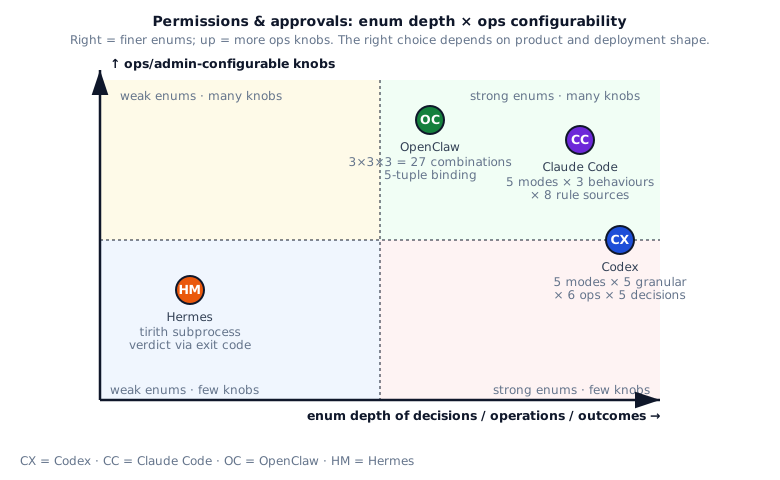
Four scenarios, four recommendations:
- Building a SaaS control plane or IDE integration: clone Claude Code’s 8 PermissionRuleSource levels + 5 PermissionMode, mirroring config layering.
- Building a serious desktop agent: clone Codex’s AskForApproval + GranularApprovalConfig + default_available_decisions().
- Giving operators real knobs: clone OpenClaw’s 3x3x3 matrix so ops can dial each dimension independently.
- Centralizing security policy + outsourcing audit: clone Hermes’s tirith pattern: subprocess + exit code + supply-chain verification.
Choice: put the veto before execution
Section titled “Choice: put the veto before execution”There is no star rating here. Start by asking who can veto an action, then place policy at the right layer.
| Constraint | Start with | Boundary to make explicit |
|---|---|---|
| A desktop agent needs one-shot and session approvals | Codex typed actions, answers, and contextual buttons | Enum evolution and approval latency |
| Enterprise settings need layered overrides and debugging | Claude Code rule sources, modes, and behaviours | Source precedence must be visible |
| Operators need separate host, filter, and ask controls | OpenClaw execution matrix and binding | Many combinations; document the common ones |
| Security scanning should be independently auditable | Hermes tirith exit-code verdict | fail_open changes the failure risk |
A prompt can express intent; it cannot replace an execution-time policy or host boundary.
Build the smallest approval loop
Section titled “Build the smallest approval loop”Below is a starting checklist from the cited implementations. Complete one auditable allow, deny, and ask loop, then add caching, policy sources, and operator controls from logs.
Build recipe
最小可行
- Define a 3-tier ApprovalMode enum (borrow from OpenClaw's ExecAsk): always-ask / on-miss / never. Three tiers are an auditable starting point; verify coverage against approval logs instead of assuming 90%
- Type the reviewable action (borrow from Codex): at minimum Command (shell command) / FileWrite (file write) / NetworkAccess (network request) / McpCall (MCP call) 4 types; different types use different prompt copy + cache strategy
- Type the user answer (borrow from Codex): Approved (just this once) / ApprovedForSession (allow same requests within this session) / Abort (reject and abort) 3 types; ApprovedForSession is a practical lifesaver (no need to ask every time)
- Cache approvals by (argv, cwd, agentId) triple (a simplified OpenClaw SystemRunApprovalBinding): preventing "approved git push in ~/projects/A then agent runs to ~/projects/B and can push too" privilege escalation
进阶
- AskForApproval 5 variants (borrow from Codex): UnlessTrusted / OnRequest / Granular (five flags) / Never + one deprecated compatibility value. The snapshot exposes five choices; validate their fit against approval logs and management policy
- GranularApprovalConfig (borrow from Codex): independent booleans for sandbox / rules / mcp / skill / request_permissions; this "broken into sub-switches" lets different teams precisely select their own risk profile
- Layered PermissionRuleSource (borrow from Claude Code): 8 sources: user / project / local / flag / policy / cliArg / command / session; multiple sources let enterprise admin force policy (highest priority) and developers override at project layer
- envHash in the binding (borrow from OpenClaw): defends env-swap attacks (attacker changes PATH so git points to malicious script, sneaks through existing git approval); envHash mismatch invalidates approval
- Smart button inference (borrow from Codex' default_available_decisions): picks buttons from request context (e.g. git push --force doesn't show "ApprovedForSession" button, forcing every-time prompt)
- plan mode (borrow from Claude Code): disable side-effect tools such as Edit / Bash / Write so the model plans without acting; use it for PRD, requirements, or code review only when the workflow policy calls for it
- Outsource content scanning to subprocess (borrow from Hermes' tirith): independent subprocess for content safety, exit code is verdict source of truth (don't care if subprocess crashes / output JSON errors), JSON only enriches findings without affecting verdict
- fail_open config fallback (borrow from Hermes): environments that permit checker degradation may choose fail_open=true with a prominent warning; set fail_open=false and enforce it through policy when the checker is a mandatory security gate
一开始别做
- Don't encode "mode" as a single string ("--yolo" / "--strict"): evolution forces new values, migrations hurt; users can't distinguish strings; use enum + descriptors (each enum value with doc string)
- Don't entangle permission rules with tool list: separate toolName from ruleContent for cross-tool composability (one rule applies to multiple tools); entangling means copying rules for each new tool
- Don't let model decide when to ask: model biases toward "ask less, finish faster" (less user friction = better finish rate), but safety drops; server-side policy enforcement is reliable
- Don't cache approvals by single ID: argv + cwd + env hash all matter, otherwise one approval grants the world (approval in project A can run in project B); this is a common privilege-escalation entry
- Don't skip cosign / SHA-256 supply-chain checks: auto-downloading safety check binaries is also an attack surface (attacker replaces binary on CDN); after download must verify signature + check SHA
Put decision differences back in context
Section titled “Put decision differences back in context”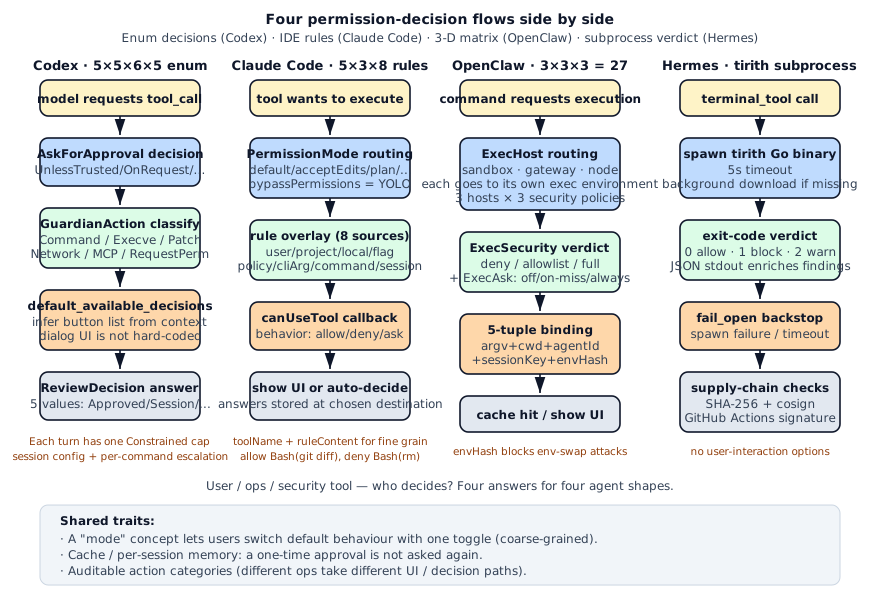
Lined up, “who has authority” is one glance: Codex / Claude Code let users tune, OpenClaw gives operators knobs, Hermes hands the gavel to an independent tool.
How to verify approval decisions and rule sources
Section titled “How to verify approval decisions and rule sources”What to carry forward and the next experiment
Section titled “What to carry forward and the next experiment”Human-in-the-loop is not a confirmation dialog; it is an action-level authorization contract. Displayed content, final arguments, execution identity, and host policy must point to one immutable action.
Next experiment: test argument mutation after approval, token replay, cross-user use, expiry, and subagent privilege escalation. Every case should deny or ask again, while audit records the original action, the difference, and the decision reason. If approval can drift or be reused, the human gate is only visual.
Appendix: exercises and review
Section titled “Appendix: exercises and review”Open the exercises and ten review questions
Exercises
Section titled “Exercises”- Easy: implement
ApprovalModewith three levels (always-ask / on-miss / never). Allowlist hits pass through; misses defer to mode. - Medium: cache approvals via (argv, cwd, env_hash) triple. Verify: changing env_hash (editing PATH) misses the cache and re-prompts.
- Medium: implement
available_decisions(request). When the request carriesproposed_execpolicy_amendment, add an “Approve + add to policy” button. Verify: plain command shows Approve/Abort; network request shows four buttons. - Hard: implement multi-source rule loading. Stack user / project / local / cliArg / session in that order; later layers override earlier. Verify:
--allow-bashon cliArg overridesBash: denyin projectSettings.
Review questions
Section titled “Review questions”Q1 · Concept: Why does Codex use an enum for the approval mode instead of a string?
Enums enforce four guarantees a string cannot:
1. Compile-time exhaustiveness. Rust match AskForApproval { ... } rejects missing arms. Adding Granular(GranularApprovalConfig) forces every dispatch site to be updated. A string if-else chain misses a branch and only blows up at runtime. When Codex added Granular, roughly 30 match sites lit up simultaneously and had to be handled before compilation succeeded.
2. Explicit evolution paths. OnFailure is marked deprecated but still in the enum. Enums make “deprecated yet compatible” a first-class case rather than the implicit “wrap in if version < X somewhere” that strings encourage. New code rejects OnFailure for new sessions (CLI parser denies it) but resumed sessions still parse it cleanly.
3. Serialization that aligns front and back. #[serde(rename = "untrusted")] lock-steps Rust types with the JSON protocol. The TUI, Plugin SDK, and IDE webview all see exactly the same string set; docs and editor auto-completion derive automatically. String-based designs frequently end up with “audit” and “audit_mode” both accepted by accident.
Source: codex/codex-rs/protocol/src/protocol.rs:889-920.
Follow-up: “What if you really need 50 modes?” Use layered enums: AskForApproval::Custom(CustomMode) with CustomMode being a user-defined struct. Codex’s Granular is already a hint of this approach.
Q2 · Concept: How are Claude Code’s 8 PermissionRuleSource layers prioritized, and why can’t they be collapsed?
The 8 sources are not redundancy. They correspond to 5 layered config files plus 3 transient origins:
5 permanent layers (ascending priority, later overrides earlier):
userSettings(~/.claude/settings.json): global user preferenceprojectSettings(.claude/settings.json): committed project shared configlocalSettings(.claude/settings.local.json): project-local gitignoredflagSettings: CLI startup flagspolicySettings: enterprise IT policy (highest)
3 transient origins:
cliArg: one-shot--allow-bash-style argcommand: slash command injectionsession: user-granted in-session
Why can’t they be collapsed?
Merging user/project/local into one “config” breaks team workflow. Project-shared config must not be overridden by personal preference (otherwise after git pull your rules silently change), and personal preference must not be overridden by project config (otherwise SSH-ing to a different machine forces you to reconfigure everything).
All three layers have clear real-world scenarios.
policySettings deserves its own layer for one enterprise scenario: IT deploys a “no Bash(rm -rf)” policy, and developers cannot override it through any of user/project/local/cliArg. That’s a compliance requirement.
Source: claude-code/src/types/permissions.ts:220-242.
Follow-up: “Last-wins or most-restrictive for conflict resolution?” Claude Code uses last-wins. Reasoning: an explicit --allow-bash on cliArg should override projectSettings’ deny. With most-restrictive, cliArg is useless.
Q3 · Architecture: Why does OpenClaw’s 5-tuple binding include envHash?
To defend against env-swap stealing of approval. Concrete attack:
- User approves
python script.pywhilePATH=/usr/bin(cache that approval) - Attacker flips
PATH=/tmp/evil:/usr/binsopythonresolves to a malicious binary - Agent’s next
python script.pymatches binding (argv, cwd, agentId, sessionKey) and hits cache, skipping approval, running the malicious binary
envHash folds PATH and other relevant env vars into the binding. Env change → cache miss → re-prompt. Same argv and cwd, fresh approval required.
Why not ban all env changes?
Agents constantly switch env (activate venv, source .env, export temp vars). Re-prompting every time is a UX disaster. envHash makes only the env vars that actually affect lookup (PATH, LD_LIBRARY_PATH, etc.) trigger reapproval; cosmetic env vars (PS1, TERM) are ignored.
Implementation detail: OpenClaw hashes only a security-relevant env subset, not all env. The exact list lives in infra/exec-approvals.ts.
Source: openclaw/src/infra/exec-approvals.ts + infra/system-run-approval-binding.ts.
Follow-up: “How do Hermes/Codex defend against this?” Codex uses inherited_exec_policy (chapter 10) + Granular sandbox_approval to enforce sandbox-level isolation; Hermes delegates to tirith which re-analyzes every command (no cache to poison). Different solutions, same attack surface covered.
Q4 · Concept: Hermes outsources permission decisions to the tirith subprocess. Benefits and costs?
Benefits:
- Separation of concerns. The agent cares about business and UX; tirith cares about security decisions. They evolve independently: tirith pushes new rules without Hermes changing code, Hermes refactors dialog flow without touching security.
- Cross-language reuse. tirith is a Go binary callable by Hermes (Python) / Codex (Rust) / Claude Code (Node). One ruleset across every agent.
- Sandbox isolation. tirith runs in a separate process; crashes, hangs, or memory leaks do not impact the main agent. Supply-chain attacks have a smaller blast radius.
- Fast zero-day response. New attack patterns ship as a new tirith binary (cosign-verified + auto-download). Every dependent agent gets the protection automatically.
Costs:
- Spawn per call. Every tool call adds process startup, loading, and IPC work. The source gives no portable 5-50ms or
<1μsbenchmark; measure the two paths on the target platform. - fail_open is a dilemma. Production fail_open=false makes a flaky tirith DoS your own agent; dev fail_open=true equals no security. No middle ground.
- No user override. False positives only fix via tirith rule updates; users cannot say “I confirm this is OK.” UX is worse than Codex/Claude Code.
- Supply-chain overhead. Auto-download + SHA-256 + cosign + version compatibility + fallback paths all need engineering.
Fits: server-side agents, latency-tolerant, centralized security policy. Doesn’t fit: desktop agents where every tool call eating a subprocess kills UX.
Source: hermes-agent/tools/tirith_security.py:1-150.
Follow-up: “Long-running tirith daemon instead of spawn-per-call?” Possible, but you take on IPC, state sync, and daemon crash recovery. Spawn-per-call is Hermes’s tradeoff for simplicity over performance.
Q5 · Concept: Why does default_available_decisions() infer buttons from context?
Different requests need different buttons:
- Plain shell command: user picks Approve once or Abort. Two buttons suffice.
- With execpolicy amendment: user may want “Approve plus add to policy” beyond the one-shot Approve. Extra
ApprovedExecpolicyAmendmentbutton. - Network access: user may want “this once,” “whole session,” or “permanently allow this domain.” Three escalating allow tiers plus Abort = 4 buttons.
- Extra file permissions: yes or no, no amendment button needed.
If the button list is hardcoded, either the UI shows all five buttons all the time (users confused: “what is this amendment button doing here?”) or if-else chains scatter across the UI codebase (each new case touches the UI).
default_available_decisions(ctx) centralizes “which buttons to show” in the protocol layer. The UI renders whatever list it receives, no logic of its own.
Frontend / TUI / VS Code extension / IDE webview all show the same buttons and never drift.
Analogy: form systems with “field schema → form fields.” Structured schema decides UI, UI carries no if-else.
Source: codex/codex-rs/protocol/src/approvals.rs:288-322.
Follow-up: “Difference between ApprovedForSession and ApprovedExecpolicyAmendment?” ApprovedForSession lasts the session only (lost on restart); ApprovedExecpolicyAmendment writes to the user execpolicy file and persists across sessions. Short-term trust vs long-term trust.
Q6 · Real-world: Building approval into your agent, from zero to production?
Advance through four scopes: enum basics → cached binding → multi-source rules → subprocess audit. Gate each scope on authorization, cache, and audit fixtures before adding the next.
Stage 1 · enum basics
class ApprovalMode(Enum):    ALWAYS_ASK = "always-ask"    ON_MISS = "on-miss"  # ask only on miss    NEVER = "never"      # YOLO / CI
class ApprovalAction(Enum):    COMMAND = "command"    FILE_WRITE = "file_write"    NETWORK = "network"    MCP_CALL = "mcp_call"
class ApprovalDecision(Enum):    APPROVED = "approved"    APPROVED_SESSION = "session"    ABORT = "abort"
Borrow Codex’s typed approach. Every enum has clear semantics.
Acceptance gate: unit tests cover allow, ask, session, and abort decisions; the UI renders the schema returned by default_available_decisions.
Stage 2 · cached binding (defend env-swap)
Prerequisite: Stage 1 action and decision semantics are fixed.
@dataclassclass ApprovalBinding:    argv: tuple    cwd: str    agent_id: str    env_hash: str
    def __hash__(self): return hash((self.argv, self.cwd, self.agent_id, self.env_hash))
cache: dict[ApprovalBinding, ApprovalDecision] = {}
def check_approval(action: ApprovalAction, args):    binding = compute_binding(args)    if binding in cache: return cache[binding]    decision = ask_user(action, args)    if decision == APPROVED_SESSION: cache[binding] = decision    return decision
Borrow OpenClaw’s 5-tuple binding.
Acceptance gate: the same binding hits cache, while any cwd, argv, agent, or env_hash change misses and is audited.
Stage 3 · multi-source rules
Prerequisite: user, project, local, CLI, or session rule stacking is a real requirement.
class RuleSource(Enum):    USER_SETTINGS = 1    PROJECT_SETTINGS = 2    LOCAL_SETTINGS = 3    CLI_ARG = 4    SESSION = 5
def load_rules() -> list[PermissionRule]:    rules = []    rules.extend(load_user_settings())    rules.extend(load_project_settings())    rules.extend(load_local_settings())    rules.extend(load_cli_args())    rules.extend(load_session_rules())    return rules
Borrow Claude Code’s 8-source design.
Acceptance gate: a fixed conflicting-rule fixture produces deterministic precedence, with source and final verdict traceable.
Stage 4 · subprocess audit (when needed)
Prerequisite: untrusted commands or compliance require an external scanner.
def deep_check(command: str) -> Verdict: result = subprocess.run( ["tirith", "--scan", command], timeout=5, capture_output=True, ) if result.returncode == 0: return Verdict.ALLOW if result.returncode == 1: return Verdict.BLOCK if result.returncode == 2: return Verdict.WARN return fail_open_config or Verdict.BLOCKBorrow Hermes’s tirith pattern.
Acceptance gate: allow, warn, block, and scanner-unavailable verdicts have contract tests, and fail-open/closed behavior follows policy.
Key takeaways:
- Fix enums first, not strings: evolution misery starts here
- Enable cached binding after fixtures pass: avoid “same argv prompts twice” UX disaster
- Multi-source rules only when team scenarios show up: solo use needs user_settings + cliArg
- Subprocess audit is for enterprise: skip for self/desktop agents
Follow-up: “How do you test this?” Three layers: (1) unit tests on enums and decision functions; (2) integration tests for binding cache hit/miss; (3) E2E tests confirming user approval → cache → subsequent same binding doesn’t re-prompt.
Q7 · Architecture: Why does Claude Code keep plan as a separate mode?
plan lets the agent “think but not act.” Concrete behavior: every side-effect tool (Bash / Write / Edit / NotebookEdit / WebFetch / TaskCreate) is disabled, leaving only read tools (Read / Grep / Glob) plus writing a todo / plan document.
Why not just dontAsk plus a model that behaves?
Models are unreliable. “Plan only, don’t act” gets followed by most models, but a non-trivial fraction will pivot to “I see a bug, let me fix it.” plan mode pulls every side-effect tool from the toolbox at the framework level; the model can’t act even if it wants to.
Hard constraint beats prompting.
Why not bypassPermissions plus user denials each time?
bypassPermissions means “don’t prompt,” not “don’t execute.” User denial is post-hoc and can’t undo what happened (a rm already ran). plan is pre-emptive.
plan and acceptEdits are opposite poles:
- acceptEdits: auto-approve all edits, minimal interruption
- plan: disable all side effects, maximum protection
Both “don’t prompt” but with opposite behaviors. Enum lets users one-click switch instead of hand-composing 8 sources.
Fits:
- User gives a complex prompt and wants to review the agent’s plan before letting it execute
- Team code review: agent proposes changes without touching code directly
- Unfamiliar codebase: plan first, then step through together
Source: claude-code/src/types/permissions.ts:198-204.
Follow-up: “Can users exit plan mode mid-flow?” Yes. Claude Code lets users /exit-plan after planning to return to default. The plan document becomes context for subsequent turns.
Q8 · Real-world: Users complain “approval prompts interrupt my flow.” How to improve?
Four layers: cache → broaden scope → auto-classify → trust modeling.
Layer 1 · Cache coverage
Most common failure: users re-approve the same command repeatedly. Check:
- Binding stability (no invalidation on unrelated env changes)
- ApprovedForSession explicitly selectable
- argv normalization (
ls -lvsls -l ./should collapse)
Layer 2 · Approval scope
Let one approval cover more:
Prompt: "Run `npm install`?"Buttons: [Approve once] [Approve all npm commands] [Approve all in this cwd] [Abort]Borrow Codex’s multi-button approach. Let users choose trust scope.
Layer 3 · Auto-classify (safe commands pass through)
is_safe_command() (Codex has one): pure-read commands (cat / ls / git diff / grep) auto-pass. Restrict from source:
- Writes (rm / mv / cp) → ask
- Network (curl / wget) → ask
- Interpreter exec (python / node / bash -c) → ask
- Pure read (ls / cat / grep) → pass
Layer 4 · Trust modeling
After stable agent behavior, gradually relax:
- First 100 turns: every non-read command prompts
- 100-1000 turns: a threshold such as < 5% denial rate can be a guarded-trial input; calibrate it from your logs and do not auto-pass without audit and rollback controls
- 1000+ turns: expert user, default acceptEdits
Like Sublime’s “recently used commands” concept, tuned to actual usage.
Anti-patterns:
- Drop to bypassPermissions: solves nothing, kills security
- LLM as gatekeeper: inconsistent decisions, can’t build stable trust
- Time-limited approvals: user looks away → timeout denies → UX disaster
Hermes take: tirith makes auto-decisions, no prompt. Pro: no prompts. Con: false positives only fixable via rule updates. Different UX tradeoff.
Source pointers: Codex is_safe_command() + default_available_decisions() + ApprovedForSession. Claude Code permissionsLoader.ts 8-source stacking + session cache.
Q9 · Engineering: cosign / SHA-256 / auto-download as a real-world supply chain story?
Hermes auto-downloading the tirith binary is a typical supply chain entry point. Three layers of defense:
Layer 1 · HTTPS + SHA-256 (mandatory)
- Download over HTTPS (defends transport tampering)
- SHA-256 verify after download (defends server-side compromise that pushes a malicious binary)
- SHA-256 hash lives separately from the binary (hash in release notes / metadata, binary in release artifacts)
Layer 2 · cosign provenance (optional but strongly recommended)
cosign verifies the GitHub Actions workflow signature:
- Who triggered the build (PR number / commit SHA)
- The workflow file itself (
.github/workflows/release.yml) - The commit hash at build time
Meaning even if attacker:
- Gains upload privilege to GitHub release artifacts → cosign verify fails
- Modifies the release workflow → workflow hash diverges from history
- Steals a maintainer’s local GPG key → cosign still detects “this binary was not produced by GitHub Actions”
Layer 3 · Background download / non-blocking startup
If download sits on the main path, a 30-second first-launch wait is awful. Hermes spawns a background thread to download without blocking input.
Without tirith installed, the first tool call falls back to fail_open behavior (or blocks waiting for the download, per config).
Anti-patterns:
- Skip SHA-256 because HTTPS is enough → wrong. CDN compromise or Cloudflare bugs both break HTTPS-only.
- SHA-256 hash co-located with binary → attacker swaps both. Hash must come from an independent trusted source (release notes / metadata API).
- Force cosign fail-on-missing → not every user installs cosign; fall back to SHA-256-only. Hermes goes “best-effort cosign + mandatory SHA-256.”
Industry parallels:
- npm:
package-lock.jsonfor version lock + HTTPS registry. SHA verification present but not enforced. - Docker: image digest (content-addressable). Download is verification.
- Hugging Face model hub: commit SHA + LFS SHA. Similar to Hermes.
Source: hermes-agent/tools/tirith_security.py:25-150 (download + verification logic).
Q10 · Open-ended: Design a permission framework from a threat model and state every grant scope.
7 layers, opt-in:
Layer 1 · Mode enum (mandatory)
enum ApprovalMode { AlwaysAsk = 'always-ask', OnMiss = 'on-miss', GranularConfig = 'granular', Plan = 'plan', Never = 'never',}Borrow Codex 5 + Claude Code plan.
Layer 2 · Action enum (mandatory)
type ApprovalAction = | { type: 'command'; argv: string[]; cwd: string } | { type: 'file_write'; path: string } | { type: 'network'; host: string; port: number } | { type: 'mcp_call'; server: string; tool: string } | { type: 'patch'; files: string[] } | { type: 'request_permissions'; perms: string[] };Borrow Codex GuardianAssessmentAction.
Layer 3 · Decision enum (mandatory)
type ApprovalDecision =  | 'approved'  | 'approved_session'  | 'approved_amendment'  | 'abort';
function availableDecisions(action: ApprovalAction): ApprovalDecision[] {  // Borrow Codex default_available_decisions}
Layer 4 · Cached binding (recommended)
interface ApprovalBinding {  argv: string[];  cwd: string;  agent_id: string;  session_key: string;  env_hash: string;}
class ApprovalCache {  get(binding: ApprovalBinding): ApprovalDecision | null;  set(binding: ApprovalBinding, decision: ApprovalDecision): void;}
Borrow OpenClaw 5-tuple.
Layer 5 · Multi-source rules (recommended · team scenarios)
type RuleSource = 'user' | 'project' | 'local' | 'flag' | 'policy' | 'cliArg' | 'command' | 'session';
interface PermissionRule {  source: RuleSource;  behavior: 'allow' | 'deny' | 'ask';  toolName: string;  ruleContent?: string;}
function loadRules(): PermissionRule[];
Borrow Claude Code.
Layer 6 · Subprocess audit (optional · enterprise)
interface DeepCheck {  scan(command: string): Promise<DeepCheckVerdict>;}
type DeepCheckVerdict = 'allow' | 'block' | 'warn' | 'fail_open';
Borrow Hermes tirith.
Layer 7 · Smart buttons (recommended)
function renderApprovalUi( action: ApprovalAction, decisions: ApprovalDecision[],): ApprovalDialog;Borrow Codex context-driven buttons.
Contributions per system:
- Codex: mode enum + action enum + decision enum + smart buttons
- Claude Code: 8-source stacking + plan mode + per-tool ruleContent
- OpenClaw: 5-tuple binding + envHash env-swap defense
- Hermes: subprocess audit + supply-chain verification
Evaluate by scope:
- Layers 1-3 · typed decision core: fix the mode, action, decision, and button-inference contracts first. Gate: unit tests cover allow, ask, and abort; the UI only renders buttons returned by the schema.
- Layers 4-5 · binding and rule sources: add only when session reuse or user/project/CLI rule stacking is required. Prerequisite: the binding includes cwd, argv, agent, and
env_hash; gate: hit/miss, env-swap, and rule-precedence fixtures agree with the audit record. - Layers 6-7 · subprocess and supply-chain audit: add only for untrusted commands or enterprise compliance. Prerequisite: fail-open/closed policy is explicit; gate: allow, warn, block, and auditor-unavailable verdicts each have contract tests.
Key decisions:
- Prefer enums, never strings
- Every enum needs a
default_available_xxxsmart inference function - Cached binding must include env_hash
- Subprocess audit’s fail_open must be explicit, not default
Follow-up: “Cross-language sharing?” Core enum + binding schema in JSON Schema; codegen types for TypeScript / Rust / Python / Go. Decision logic stays per-language (can’t share if-else across languages), but protocol and data format align.
Source route: Codex shows typed approvals, Claude Code rule sources, OpenClaw hosts and bindings, and Hermes an external verdict. Their grant semantics differ, so do not combine them verbatim; select by threat model and add contract tests.