Agent Mechanics
Engineering promise
Make agents runnable. Then make them trustworthy.
Agent Mechanics does not rank frameworks. It uses real source code, fault injection, and reproducible labs to turn stopping, recovery, verification, permissions, memory, and multi-agent coordination into mechanisms you can inspect.
Enter by current problem
You do not need to read in order.
Choose the failure happening now. Each route gives the boundary and decision first, then leaves source code, diagrams, and implementation detail for deeper verification.
Hands-on labs
Every reading path should leave a runnable artifact.
Three standard-library Python labs turn recovery protocols, tool gates, and context budgets into objects you can fault-test, rerun, and submit with an acceptance report.
Core trade-off
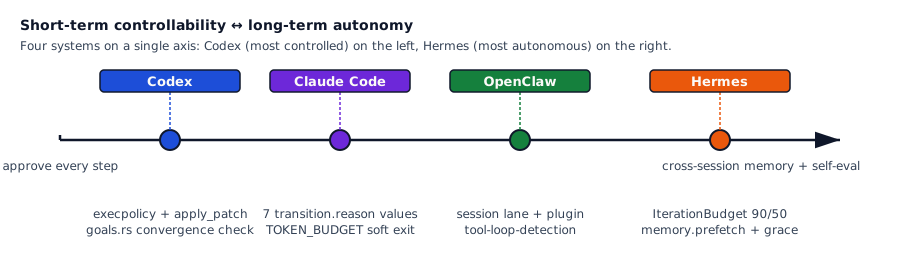
Decide whether you need control or autonomy.
This isn’t a leaderboard. The systems sit on one trade-off axis: toward the left, every step is auditable; toward the right, cross-session memory buys long-term autonomy.
System evidence
Don’t copy their shape. Copy their judgment.
Apply the findings
Turn mechanism judgments into constraints for the next build.
build-your-own-agent compresses the conclusions into 10 hard rules, an 8-dimension selection matrix, a Python scaffold, diagnostics, and a security checklist.